Showing posts with label Vicenary Ports Pact. Show all posts

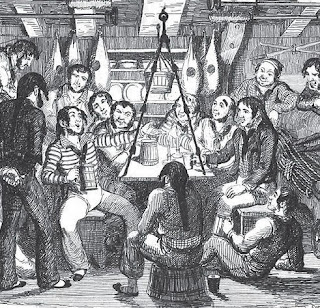
Oath Upon the Deep

Before wind and wave, I pledge to keep the peace on deck, obey the captain’s word, and care for the safety and good of all aboard, until we set foot again upon the shore.

The Ivory Tower of Sabaha

The Ivory Tower of Sabaha is the headquarters of the Administrative Council of Vicegerents and the Admiralty.

The Council is comprised of the Vicegerents sent by each of the twenty Viceroys to Sabaha. They are joined by the Admiral himself. It decides all matters that come before its body with a simple vote of the twenty-one members. It sets prices, costs and duties. It also selects and reassigns a new Viceregent or Admiral whenever a vacancy occurs. It deliberates on possible military or enforcement matters whenever a Viceroy asks for assistance.

Each Vicegerent has a handful of undersecretaries who report to him, and who can act as his proxy in any votes that are undertaken while he is physically out of the Ivory Tower. In like manner, the Admiral has undersecretaries of the Admiralty who are able to act in his stead. For this reason the Council always has quorum and meets every day at noon, but an emergency session can be demanded whenever four Vicegerents (but not their undersecretaries) agree to hold a meeting.

In all other matters the individual Viceroys have near plenary power in their individual offing. Each Viceroy also has the authority to recall his Vicegerent and to install another, at his sole discretion.

The Vicenary Pharoi

Seafarers are frequently greeted by the comforting loom of the Vicenary Pharoi. In most places, this light can be seen at about 25 miles distance, weather permitting. For the seafarer, this means not only a safe port and a journey's end, but subjecting himself to the rule of a political structure larger than that of the absolute rule of his ship's captain. Learned men of the sea refer to this political structure as the vicegerency.

The vicegerency is measured as the offing, or the farthest point visible from each Pharos in each direction. A matter is "in the offing" if it comes under the jurisdiction of the Viceroy. In like manner, a sailor considers himself under the power of the Viceroy (except in the case of piracy) whenever he can see the loom of the Pharos -- the light of the tower. 

In the vicegerency of that port, the seafarer considers the Viceroy as having ultimate sway to resolve disputes and to represent seafarers before the land residents of Erenth. They do not generally take notice of landed nobles or the customs of the princes and rulers of the land. They will not avail themselves of their courts

The Pharoi of Northrun
The Sapphire Tower of Samarabad (Ald Ciula)
The Emerald Tower of Tamar (Tirgus Holm)

The Pharoi of Southrun
The Coral Tower of Uruda (Rak Gremluuk)
The Blue Tower of Byza
The Copper Tower of Qahira
The Bone Tower of Kalani (Calleny)
The Pearl Tower of Istada
The Ivory Tower of Sabaha (Tradepost)
The Jade Tower of Danab
The Topaz Tower of Isnafar
The Crocus Tower of Anshabajan

The Pharoi of Eastrun
The Gold Tower of Susa (Shu)
The Bronze Tower of Lahara (Laster Shores)
The Crimson Tower of Fah Tawaj (Free City)

The Pharoi of Westrun
The Cedar Tower of Bezapur (Bolden)
The Silver Tower of Walashabad (Watersedge)
The Ebony Tower of Tamisand (Treft)
The Rust Tower of Dabil (Dor Inur) 
The Ruby Tower of Bilishapur (Balduren)
The Sable Tower of Kashir (Tradestop)


While there are 20 different Pharoi, and the turret of each is painted for its unique name, each of the towers has the same basic architecture. The towers are four hundred feet from base to lantern tip. 

The barracks, cellars and wellroom take up the first three floors of the tower. They are only accessed through massive ironbound doors and sally ports.

The great hall of the pharos is 36 feet above ground level and can be accessed from the internal ladder or the great sweeping stone stair which spirals up the outside of the tower. It boasts a 50 foot high ceiling on a 70 foot diameter room. The floor of the great hall boasts a massive map which depicts the known seas and its shores.

The next four floors are 60 feet in diameter and 12 feet high.

The next floor is 55 feet in diameter and 12 feet high.

The next two floors are 50 feet in diameter and 12 feet high.

The next three floors are 45 feet in diameter and 12 feet high.

The Viceroy's Hall is 40 feet in diameter with a 75 foot ceiling.

The Vicereine's Apartments are 40 feet in diameter and boast two floors with 12 foot ceilings.

The Law of the Seas

1: All those who travel upon the Sea are obliged to take the Oath Upon the Deep, for even those who do not shall continue to be bound by it.

2: Piracy and witchery are crimes against all and may be avenged freely. Let them be put to death or left as flotsam for Valritra to avenge. Let those who recover pirated goods or lay hold of a witch be entitled to one-third of what is recovered, but only if the offender be returned to face his accuser.

3: All water aboard a boat will be as if entrusted to the captain. Upon need it will be his to distribute freely to all.

4: Freight is the mother of wages. A merchant shall retain six shares of safely-carried cargo. A captain's pay will include two shares; the mates will divide a share; the carpenters and boatswains will divide a half-share; the crews and cooks will divide a half-share.

5: No passenger is to cook, nor split wood, nor kindle fires aboard a ship. 

6: If a passenger comes on board and has gold, let him entrust it to the captain. If he does not entrust it and says: "I have lost gold, or silver," no effect is to be given to what he says, since he did not entrust it to the captain.

7: If a ship is lying in harbor or on a beach, and is robbed of its anchors, tackle, articles or cargo; when the thief is caught and he confesses, he should be flogged and make good the damage he has done twice over, even if he must be pressed into service until the payment is made.

8: If the sailors of a ship, by direction of their captain, steal the goods of a merchant or passenger, let the captain make good the damage twofold to those who were robbed, and let the sailor receive a hundred blows. If the sailor commits the theft of his own accord and is caught and convicted by witnesses, let him be well-beaten. Whatever he has stolen, let him make good the loss to the person robbed.

9: If a captain brings the ship into a place which is infested with thieves and pirates, although the passengers testify to the captain what is at fault with the place, and there is a robbery; let the captain make good the loss to the sufferers. On the other hand, if the passengers bring the ship in, in spite of the captain's protests, and something untoward happens, let the passengers bear the loss.

10: If sailors set to fighting, let then fight with words and let no man strike another. If a man strikes another on the head and opens it, or injures him in some other way; let the first pay the second's fees and expenses and his wages for the whole time he is away from work taking care of himself.

11: If sailors are fighting, and one strikes the other with any object, and one returns the blow; he did it from necessity. If the man who gave the first blow is killed or maimed, it is to go harmless, for he suffered what he wished to inflict.

12: If the captain is deliberating about jettison let him ask the passengers who have goods on board and let them take a vote what is to be done. Let there be brought into contribution the goods; the bedclothes and wearing apparel and utensils are all to be valued; and if jettison takes place, with the captain and passengers the loss should be proportional. 

13: If the captain and crew are negligent and there is an injury or wreck, let the captain or the crew be responsible to the merchant for making the damage good. If it is through the merchant's negligence that ship and cargo are lost, let the merchant be responsible. If no default of either captain, crew or merchant, and a loss or wreck occur, what is saved from ship and cargo is to come into contribution.

14: If a man makes a deposit in a ship or in a warehouse, let him make it with a man known to him and 'Worthy of confidence before three witnesses. If the amount is large, let him accompany the deposit with a writing. If the man who agreed to take charge of the deposit says that it is lost, he must show where the wall was broken through or how the theft took place and take an oath there was no fraud on his part. If he does not show it, let him restore the goods safe as he received them.

15: If a man hires a Ship and pays earnest money, and afterwards says: "I have no need of it," he forfeits the earnest money. But if the captain acts wrongfully let him give back to the merchant double the earnest money.

16: Where a man hires a ship, to be binding it must be in writing and signed by the parties, or it is void. Let them also write in penalties if they wish. If they do not write penalties, and there is a breach, either by the captain or the hirer-if the hirer provides the goods. . . let him give half the freight to the captain. If the captain commits a breach, let him give half-freight to the merchant. If the merchant wishes to take out the cargo, he will give the whole freight to the captain. 

17: If there is a contract between merchant and captain let it be in writing and binding. If the merchant does not provide the cargo in full, let him provide freight for what is deficient, as they agreed in writing.

18: If in the open sea a ship is overset or destroyed, let him who brings anything from it safe to land receive instead of reward one-fifth of what he saves.

19: If gold or silver or anything else is raised from the sea from a depth of eight fathoms, let the salvor receive one-third. If raised from fifteen fathoms let the salvor have one-half, by reason of the danger of the sea. Where things are cast from sea to land and found there, or carried to within one cubit of the land, let the salvor have one-tenth of what is salved.

20: If there be any persons left afloat it shall be the duty of every captain to return them to the next vicegerency. Fair passage may be charged and a week after landfall given to make good. Those who do not make good may be pressed into service to pay their debt.

The History of the Vicenary Ports

Even when the realms of men were young, trade in tin and copper was already well-established. It is true that the City of Watersedge was settled by the last of the Lanari under Tal the Just, but choosing that spot was not a happy accident. That location had been an ancient tradeport going back millennia before the Eight Kingdoms Pact. 

A similar observation could be made about each of the Vicenary Ports, in fact. These ports of call, and the routes between them were not established by men, so much as they were re-discovered by them.

Just as the Vyrum trained certain men in the mundane skills of construction and smithing, they had others who handled their shipping and trade. Once the worldwide Vyrum Empire was no more, the Vicenary Ports still had a semblance of agreement between them, even those that had been leveled and salted during the wars to end the previous age.

It would be a mistake, however, to assume that the Vicenary Ports were established by the Vyrum. In point of fact, their mighty empire only re-discovered that which had been in place under the rule of the Elves, and the Dwarves before them. The earliest charts showing the Vicenary Ports owe their existence to Gnomish Cartographers working for their Dwarven lords. It was they which first harnessed the wind and taught their people to sail. 

Each of the Viceroys of each of the ports is well aware of this connection between their trade organization and the Gnomes of Old. For that reason, the symbol of the Viceregal Tower of Ivory always rests upon a twenty-toothed gear, though it is often taken to be a darkened sun, that gear is an homage to the symbol of the Gnomish people.  

The Vicenary Ports Pact upon the Seven Seas

In the estimation of the seafarers, the ideas of  kingdom and border and fealty are overrated. To them, all that matters is the fulfillment of contracts. The movement of cargo and passengers from one port of call to the next is the highest law. Piracy is the greatest breach of it. Between the various port cities is where fortunes are won and lost, one nautical mile at a time. The only governance such men tend to recognize are the ruling authorities of the various ports.

To promote trade and to establish a common set of rules, the Vicenary Ports Pact was negotiated between twenty recognized cities the world over. The Pact creates a loose confederation between the cities and establishes a charter to govern their agreed upon Law of the Sea. The Pact provides a means to pay tariffs that are due inland. It also establishes a way to insure cargo, to certify bills of lading, and a way to negotiate fees with the guilds. The Vicenary Ports Pact also establishes a small navy (and a corps of marines) which can be augmented with privateers. The latter type will operate under letters of authority to conduct reprisals, if necessary.

This system of governance is influenced heavily by the Satrapies of Southrun, from which it draws both its inspiration and its reverence for free trade. Not surprisingly the Seaman's Argot (the thieves cant of the sea) is influenced heavily by the Dahlese language of Southrun. All documents, charters, and licensing is written in the Argot.

The Pact is administered by the Vicegerents (representatives from each of the ports) who are headquartered in Sabaha and act from high atop the Ivory Tower. There the twenty men and their various undersecretaries administer the Pact and command the Vicenary Navy and Marines.

Each port has a local authority vested in the Viceroy whose job it is to receive a bills of lading and to grant a clean bill of health to ships, and his Vice-admiral whose job it is to command the local fleet of the navy and the company of marines, and his Vicereine, whose job it is to dedicate ships.